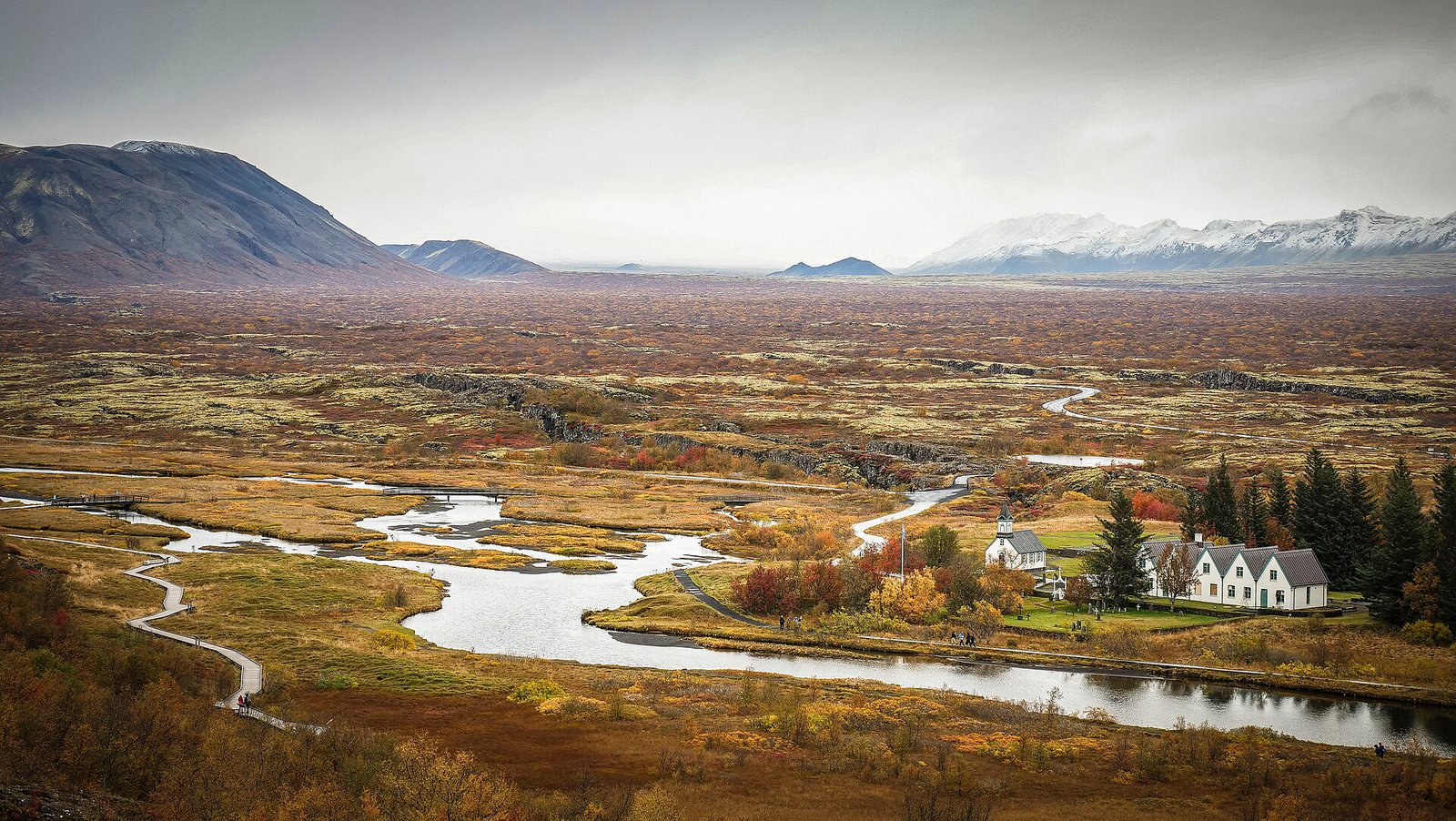
Golden Circle photoshoot guide: Þingvellir, Geysir, Gullfoss
The Golden Circle is the loop almost every visitor to Iceland drives: three hours of tarmac from Reykjavík buy a continental rift, an erupting geyser and one of Europe's great waterfalls. As a photoshoot it is a gift and a trap — variety in one morning, but at the coach rhythm of twenty rushed minutes per stop in the flattest light of the day. This guide treats the loop as a session plan: where the light is at each stop, in which order to drive it, and how long to actually stay.
The loop in numbers
Clockwise from Reykjavík: Route 36 to Þingvellir, Routes 365 and 37 past Laugarvatn to Geysir, on to Gullfoss, then Route 35 home via Kerið and Selfoss. Around 240 kilometres and three and a half hours of pure driving — so "half-day" really means five to six hours once a real session is inside it.
| Stop | Drive | Best light | Allow | Fees |
|---|---|---|---|---|
| Þingvellir | 45 min from Reykjavík | early, late, or overcast | 90 min | about 1,000 ISK per car per day |
| Brúarfoss (optional) | 35 min | bright overcast | 45 min | paid car park |
| Geysir | 15 min (50 direct from Þingvellir) | low sun; before 10:00 or after 17:00 | 40 min | paid car park (Parka app) |
| Gullfoss | 10 min | sunny late morning (rainbows) | 45 min | free at the time of writing |
| Kerið (optional) | 50 min (+60 to Reykjavík) | overcast or low side-light | 30 min | small entrance fee per adult |
Þingvellir: the stop worth ninety minutes
Anchor the loop here — it is our first pick for couples on the Þingvellir page. The Almannagjá gorge is the exposed edge of the North American plate: sheer basalt on one side, the rift valley on the other, and a wide gravel path where two people can walk, stop and talk while the photographer works around them. The walls catch low light early and late and go flat at midday, yet it also looks better under cloud than anywhere else on the loop: the moss saturates, the rock turns charcoal, and no shadows cut across faces.
Coaches arrive around ten and stay until about four; eight in the morning or after six in the evening — after nine in summer — has the path almost to itself. It is a national park and UNESCO site: paths only, no drones without a permit, and spikes in winter, when the boardwalks ice over.
A walking route with three looks
Start at the Hakið viewpoint above the P1 car park — the whole rift below, the proposal platform, quiet before ten. Walk down the gorge for the wall portraits, then take the boardwalk to Öxarárfoss, where the Öxará river drops into a pool of boulders; the gorge wall shades it from early afternoon, so the water stays soft and white. Cross the flats past the little church, Þingvallakirkja, to the quieter paths toward Silfra, where the fissures are the subject: Peningagjá, water so clear the coins on the bottom seem within reach, and a footbridge that frames a couple perfectly. Few visitors walk this section — exactly why it works for couples sessions.
Geysir: timing shots and crowd tricks
Geysir itself sleeps most years; Strokkur beside it erupts every five to ten minutes, throwing water fifteen to twenty metres up. The trick is anticipation: a second before it goes, the surface swells into a turquoise dome — pre-focus on the vent, hold burst mode from the moment the dome forms, and let the couple react rather than pose. The third or fourth eruption always beats the first, once everyone has stopped flinching.
Three crowd tricks:
- Wind: stand upwind so the spray lands on the tourists opposite, and for a glowing column put the low sun behind the water — west side in the morning, east side in the evening.
- Distance: from thirty metres back a long lens puts the couple in front of the plume and shrinks the ring of visitors to a line of tiny figures.
- Height: the path up the slope behind Geysir looks down on the whole field, steam drifting across it, Strokkur going off mid-frame.
Gullfoss: viewpoints and spray
Ten minutes on, the Hvítá river folds twice — eleven metres, then twenty-one — into a canyon invisible from the road. The upper viewpoint by the visitor centre gives scale, a couple small at the rail; the stairs and the rock ledge give drama, spray-soaked and loud, the falls filling the frame behind you. On a sunny summer day a rainbow stands in the mist from late morning into early afternoon.
Bring the rain shell: the ledge soaks you in five minutes when the wind pushes spray onto the path, and there is no shelter on the site. In winter the lower path usually closes for ice and the falls half-freeze into blue-white architecture; the upper viewpoint still works, front-lit by the low southern sun all day. Geysir and Gullfoss share one location page with photographers who shoot them regularly.
What clients say about this kind of shoot
I am a part of a choir in Iceland, and we played a part in a JCS (Jesus Christ Superstar) production at Harpa in Reykjavík, Iceland. I asked my friend Johann Smári to attend the dress rehearsal and feel free to take some photos. The outcome was amongst these 4 photos here on the site and many more outstanding shots, which we use on posters and ads for our choir. And on top of it, Jóhann Smári is a good man and nice to have around.
— Gísli F. on Johann K.
I have done a few photoshoots with Smári and always have had a great experience. He is a great photographer and has such a good eye for great locations for the kind of photoshoot I had in mind. I am always surprised at how good the photos come out. If you are looking for someone with great experience on the best places to take photos, have worked in many events and all around great at bringing art to life, through lenses, then Smári is your guy.
— Marly G. on Johann K.
We absolutely love the photos Johann Smári took of us! He is professional, friendly, and made us feel so comfortable. We're so happy with the beautiful memories he captured. Highly recommend him!
— Kara & Gummi on Johann K.
Two optional stops: Brúarfoss and Kerið
Brúarfoss is a small waterfall with an absurd colour: glacial silt from Langjökull turns the Brúará river a milky, electric blue. A signposted car park off Route 37 between Laugarvatn and Geysir now puts you a short walk from the footbridge; the old trek from the summer houses is closed. Bright overcast is best — direct sun flattens the blue. Kerið, on Route 35 near Selfoss, is a red scoria crater about 55 metres deep with a green lake at the bottom, a ten-minute rim path and a track down to the shore. It sits on the way home, the last frame of a clockwise loop; in winter the lake freezes into a white disc in a rust-red bowl.
Order of stops by light
- Summer, morning loop: Þingvellir at eight, Geysir before the coaches at ten, Gullfoss for the late-morning rainbow, Kerið early afternoon, back in Reykjavík by three.
- Summer, evening loop: drive it anticlockwise — Kerið at five, Gullfoss and Geysir as the crowds thin, then Þingvellir from nine until the light goes golden after eleven; in June it never really goes at all.
- Winter: in December the sun rises after half past ten and sets before four, so the whole loop is one long golden hour and only two anchors fit — Þingvellir at sunrise, then Geysir and Gullfoss between one and three, with the northern lights as a possible bonus over Þingvellir.
- Shoulder seasons give the best trade: late-September birch turns the rift gold, and March keeps the snow with eight hours of light.
Ninety minutes at one stop beats twenty at each
The honest advice: a session needs walking, changing light and time for two people to stop performing. Five twenty-minute stops mean three hours in a car and rushed frames beside each car park. Ninety minutes at Þingvellir gives three distinct looks, a proposal moment and quiet paths; Geysir and Gullfoss then become twenty-minute postcard stops with the pressure off. For families, flip it — anchor at Geysir, where the eruptions keep children engaged, and add Kerið's crater path.
Dress in one outfit that survives spray and wind, with a second in the car for Þingvellir — what to wear for a photoshoot in Iceland covers layers, spikes and wind. And when comparing photographers for the Golden Circle, ask two questions: do they drive or meet you there, and which stop would they anchor? If the second answer is "Þingvellir, for ninety minutes", you have found the right one.
Frequently asked questions
How long does a Golden Circle photoshoot take?
The loop itself is around 240 kilometres and three and a half hours of driving, so a full circuit with a real session inside it means five to six hours. A better plan is ninety minutes anchored at Þingvellir, with Geysir and Gullfoss as twenty-minute postcard stops. If you only have a standard one- or two-hour session, choose one stop; Þingvellir is 45 minutes from Reykjavík and gives three different looks on foot.
What is the best time of day for photos on the Golden Circle?
Before the coaches arrive around 10:00 or after they leave around 17:00. In summer an evening loop ends at Þingvellir after 21:00 in golden light that barely fades in June. In December the sun is up for only four to five hours, so the whole loop is one long golden hour and only two stops fit. Þingvellir also looks better under cloud than anywhere else on the route, so do not cancel for grey skies.
Are there fees or permits at Þingvellir, Geysir and Gullfoss?
Þingvellir charges parking per car, Geysir has a paid car park, Gullfoss is free at the time of writing and Kerið charges a small entrance fee. Þingvellir is a national park and UNESCO site: stay on the paths, use spikes in winter and do not fly a drone without a permit. Ceremonies and commercial productions need advance permission, and rules change, so check with the park or ask your photographer, who deals with them regularly.
Want professional photos on the Golden Circle?
Browse portfolios, compare packages, and book a verified local photographer in minutes.